
Case Study · AI Security & Privacy
Pragma Guard
A browser extension that nudges young people to delete old AI chats — not by lecturing them about sustainability, but by appealing to something they already care about: their own privacy.
The Brief
Combating digital hoarding, one chat at a time
The Green Office at The Hague University of Applied Sciences asked me to design a tool that would increase digital sustainability among students. The brief was intentionally open therefore I had freedom to approach the issue from any angle I saw fit.
I chose to focus on a specific, overlooked corner of the problem: digital hoarding of AI chats, and what it would actually take to get young people to delete their old conversations.
Research
Three insights from interviews, visual exploration, and desk research
I conducted extensive research combining one-on-one interviews, visual exploration exercises, and desk research into existing behaviour around AI tools. Three key insights emerged.
-
01
Users hoard AI chats based on varied emotional states rather than a tangible utility.
-
02
Lack of native organization tools in AI interfaces enlarges the issue of hoarding amongst users.
-
03
Young students have no sense of individual responsibility when it comes to the environmental impact of their digital hoarding.
Design direction
These insights pointed to a clear constraint: any tool I built would have to tackle the issue without invoking the environmental cause head-on. Instead, it needed to make users feel they were benefiting themselves first, while indirectly helping the cause.
"Young students need a system that helps them organize and delete their AI conversations in a way that aligns with how they naturally think and feel about them."
Ideation
From insight to How Might We
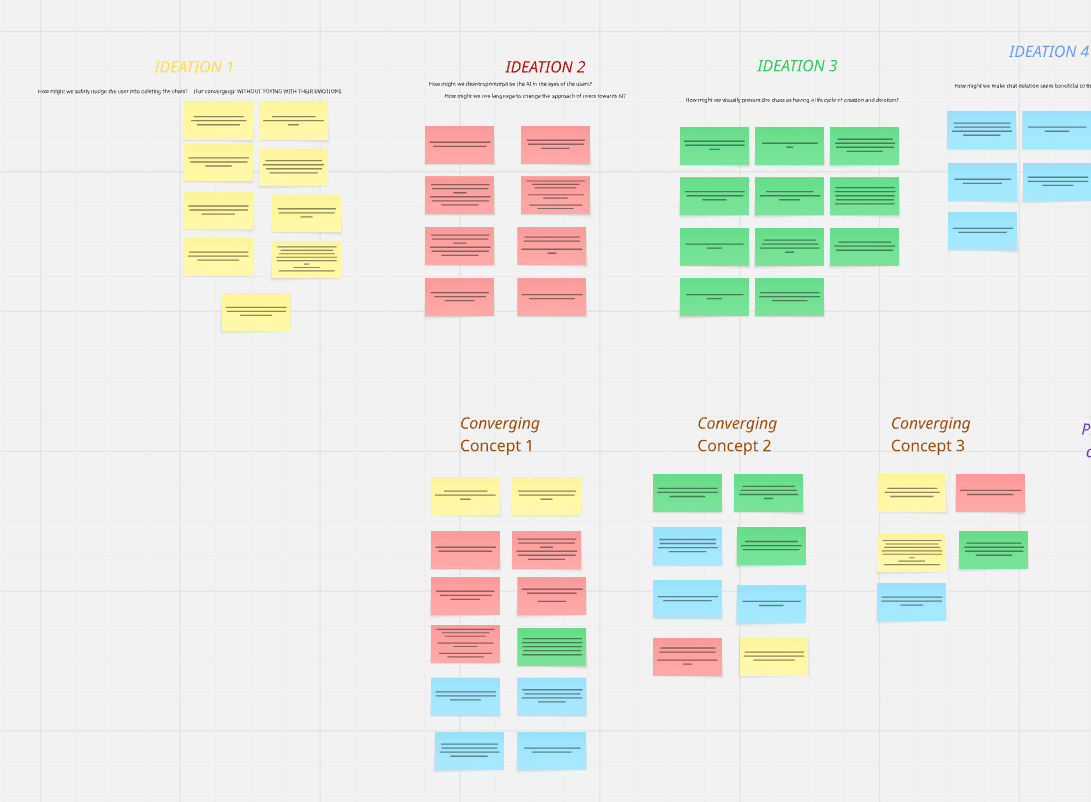
Based on the research insights, I framed four How Might We statements to open up the solution space.
How might we subtly nudge the user into deleting their chats?
How might we make chat deletion seem beneficial to the individual user?
How might we visually present chats as having a cycle of creation and deletion?
How might we de-anthropomorphise the AI in the eyes of the user?
Converging on a concept
For each HMW, I generated ideas using the Design with Intent toolkit to push past obvious solutions. When converging, I filtered every idea through three questions:
The Final Concept
Pragma Guard
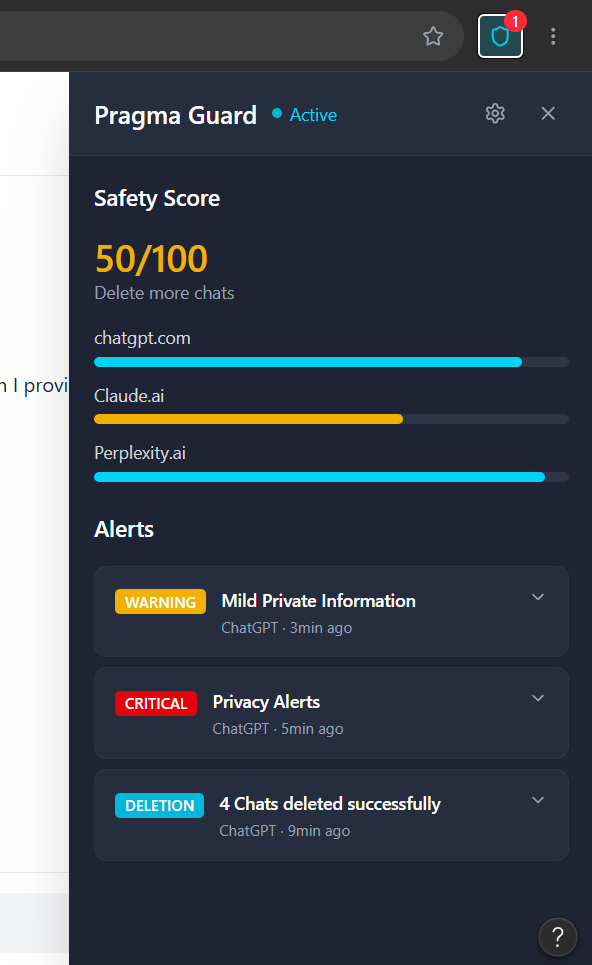
A browser extension whose main focus is helping users delete their chats by appealing to their individual desire for security and privacy. It tracks whether a user is sharing too much private or emotionally loaded information with AI tools.
The moment it detects certain keywords in a conversation, it sends a warning notification telling the user the chat should be deleted to prevent data leakage. Which reframes deletion as self-protection rather than an environmental chore.
Prototype
Bringing the extension to life
I designed the extension's core screens in Figma, then used Figma Make AI to add full interactivity to the experience. Select an option below to see each part of the flow.
Reflection
What this project taught me
I enjoyed working on this project because the final idea is original as there aren't many similar products on the market. It was built on in-depth research into the psychology of the target group, and on understanding how their minds actually work rather than how I assumed they would.
Many of the things I discovered while working on Pragma Guard have stayed with me and shaped how I approach design since, particularly the value of reframing a behaviour-change problem around what people already want, instead of what we want them to care about.